Showing posts with label Extinction Chess. Show all posts

Saturday, June 18, 2011

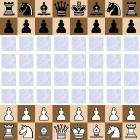
An Extinction Chess Stalemate Position


In this position, white who is to move has no legal moves to make. So it's a stalemate and the game is a draw. Please see why the white pawn at f7 cannot move.

For further information on this variant see my previous post on Extinction Chess with Mating Rules.

Tuesday, June 14, 2011

Extinction Chess with Mating Rules (Checkmate, Stalemate)

Recently, I have been trying to apply checkmate rules to Extinction Chess. Currently in Extinction Chess, when you capture the last piece of a kind, you win the game. However you could set the rules so that if there is only one piece of a kind left on the board, that piece becomes "royal". If threatened (checked), a royal piece has to get rid of the threat somehow (move outside the threat, block the threat, or capture the threatening piece). If the threat would remain, the game ends there (mate). Then, if a situation occurs where currently no royal piece on your side is threatened, however you cannot make a legal move (if any move would cause one of your royal pieces to become threatened) it would cause a draw (stalemate).


It is important to note that having multiple royal pieces on the board makes "forking" a valid way of mating. If you threaten two royal pieces of opponent with one of your pieces, the only way to end all the threats in one move is to capture the threatening piece. See the diagram above for an example (assuming both black pieces are the last of their kind ie royal).


Another way of mating that we do not see in regular chess is when a royal piece has to move to get away from being threatened, but this would cause another royal piece to come under threat. See the diagram above for an example (again, assuming both black pieces to be the last of their kind).

I think this would make Extinction Chess more in line with the original (FIDE) chess. The rules change would not matter for 99.9% of the games (except that noone would lose for forgetting their king under check). The remaining 0.1% of games would involve stalemates, for which under current rules the side who has to move their pieces into threat would lose the game. See the diagram below for an example of a stalemate. Black, to move, has no legal moves, and since white is not giving any check, the position would be a stalemate, ie a draw.

Monday, June 6, 2011

An Extinction Chess Game - 2

[Site "BrainKing.com"]
[Date "2011.06.04"]
[White "Koksal"]
[Black "Rubikon51"]

1. e4 c6 2. Nf3 d5 3. e5

Open up the position only if it suits you.

3... Bf5 4. d3 e6 5. Be2 Qb6 6. O-O c5 7. Nh4


Smell of opportunity. If black's developed bishop is captured, other bishop might come under attack either by f4-f5 pawn push, or via a3-f8 diagonal by white's c1 bishop.

7... Bg6 8. f4 Ne7 9. g4 h6 10. Nxg6 Nxg6 11. b3 Nc6 12. f5

So far, going as planned: putting pressure on black's only bishop.

12... Ngxe5 13. fxe6 f6 14. Rf5


Use your rook when you can. A rook is an effective tool to trade for knights and bishops, since most times the other rook doesn't see any play for a long time anyway.

14... O-O-O 15. Qf1 Be7 16. Rxe5 Nxe5 17. d4


This seems to be the winning move here. Opens up the necessary e2-a6 diagonal, and blocks black's d4 push. The rest of the game is a chain of obligatory moves by black, where white will win by threatening the black knight and bishop to black's eventual demise.

17... Nc6 18. Bb5 Nb8 19. Bd7 Rxd7 20. exd7 Kd8 21. Qf5 cxd4

Here the threat is 22. Qg6. 21... c4 move, threatening check from d4, loses too: 21... c4 22. Bf4 Na6 23. Qxd5 Rf8 24. Qe4 Bb4 25. c3 Ba5 26. b4 etc.

22. Bf4 Na6 23. Qd3 Nb4 24. Qd2 Nc6 25. Qe2 Bf8 26. Qe6 1-0

Wednesday, June 1, 2011

An Extinction Chess Game

[Site "BrainKing.com"]
[Date "2011.05.31"]
[White "monty bridge"]
[Black "Koksal"]

1. d4 Nf6 2. c4 e6 3. a3 b6 4. Nc3 Bb7 5. Bg5 Be7

To my knowledge opening theory is not well established in Extinction Chess. Generally players use their bishops and knights from one side freely, while they keep the other side either closed, or underdeveloped. You want ample room for maneuvering, and threatening for favorable piece exchanges, but not too much room so you don't get invaded. In this game I do not like black's position so far, seems too passive to me.

6. f3 h6 7. Bh4 g5 8. Bg3 d6 9. e4 Nh5 10. Bf2 f5


Again, it's all about Lebensraum. You have to have some maneuvering space, even if it weakens your king's side. Here, strong White center has to be attacked somehow, and there are not many ways to do that.

11. exf5 exf5 12. Bd3 O-O 13. Qc2 Ng7 14. c5 dxc5

As said earlier, white left his king's side undeveloped and black is trying to keep his queen's side closed. Hence white is attacking on the queen's side to break black's defenses.

15. dxc5 Nc6

The knight at g7 seems safe, so the other knight can see some action.

16. Rd1 Qe8 17. Qe2 Qg6 18. cxb6 axb6 19. Bb5 Bc5


White's b5 bishop is too exposed. Attacking white's other bishop is the way to go.

20. Qc4 Kh8 21. Bxc5 bxc5 22. Qa2 Rfe8 23. Kf2 f4 24. Ne4 Rxe4 25. Qb1 Qe6 26. fxe4 c4


The b5 bishop probably cannot be saved anymore. Hence white loses.

27. Rd5 Na5 28. b3 c6 29. Ba4 Nxb3 30. Rd8 Rxa4 0-1